
There are five versions of this painting. Four of them are in museums, and the fifth is in the private collection of a royal family. The largest of the five sold in 2011 for a figure reported around 250 million dollars, which made it, for a few years, the most expensive painting ever sold. That is the version with five figures — three men at the table and two standing behind them. The other four versions reduce the cast, and the most famous of them, the one at the Courtauld in London, has only two men. Both of them are playing cards. Neither of them is looking at his hand. That is where the painting begins.
Paul Cézanne painted the Card Players between roughly 1890 and 1895, near the end of a decade he spent mostly on his family estate in the south of France. He was fifty when he started the series, and he had already been through more than twenty years of being called a failure by the Paris art world. He had inherited money from his father, so he did not need to sell anything. He could work on a single subject for years, and the Card Players is the clearest example of what that freedom gave him.
What the Painting Shows and What It Does Not
In the Courtauld version, two men sit at a table facing each other. On the left, a man in a blue jacket leans forward on his elbows, smoking a pipe. On the right, a man in a wide-brimmed hat holds two cards and looks down at them. The table between them is covered with a cloth. Two wine bottles sit against the wall behind the right-hand figure. The wall itself is bare, a pale ochre with hints of blue in the shadow. There is no floor visible, no window, no clock, no other room. Everything that is not the men and the table has been removed.
This is unusual for the period. A genre scene of men playing cards was a standard subject in French painting, and it usually came with props: a coffee cup, a newspaper, a lamp, a dog under the table, a woman in the background. The Dutch and Spanish painters who invented this genre in the seventeenth century loved to fill the frame with detail. Cézanne stripped every detail out. He kept the two bodies, the pipe, the cards, the bottles, and the cloth, and let the rest of the canvas become quiet.
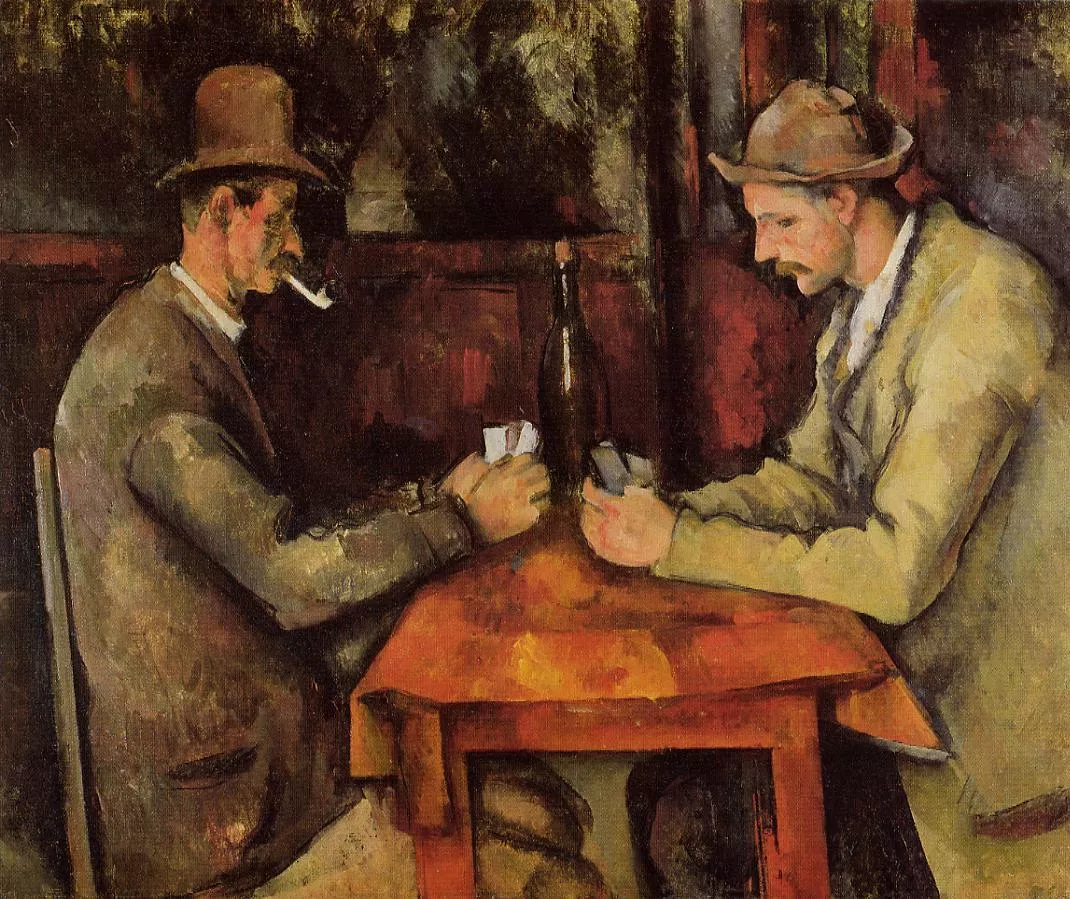 The Card Players, 1890 to 1895. Oil on canvas, 47 by 57 centimetres. Courtauld Gallery, London. One of five versions Cézanne painted on this subject.
How He Painted the Two Men
Start with the hands. The left figure holds his pipe with two fingers, thumb and index, and the hand is painted flat. It is not a caricature of a hand, and it is not a study of anatomy either. It is three or four patches of ochre and shadow that read as a hand because the eye assembles them. The right figure holds his two cards in a similar way: the fingers are implied, not modelled, and the cards themselves are two small rectangles of pale colour with a dark edge.
Now the faces. Neither man has an expression. The man on the left has his chin lifted slightly, and his eye is a dark mark under a brow. The man on the right looks down at his cards, and his face is almost entirely in shadow under the hat. You cannot tell what either of them is thinking, and you cannot tell whether one is winning or losing. Cézanne did not paint the game. He painted the room around it and the way four shoulders occupy it.
The colours are muted. Blue and ochre dominate, with touches of pale flesh and a slightly greenish yellow in the wall. There are no reds, no bright yellows, no warm tones that would draw the eye to a single point. The painting is almost monochrome, and it is held together by the blue of the left man's jacket and the blue of the shadow behind the right man's head. Everything else is quiet.
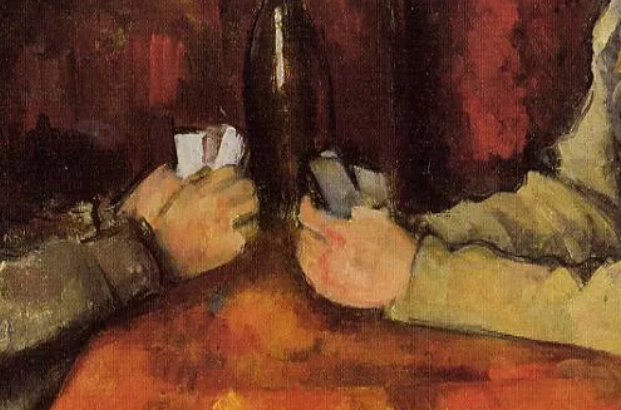 The hands are three or four patches of colour, not modelled anatomy. The eye assembles the fingers from the shapes rather than from outlines.
The Series and the Version in Qatar
Cézanne worked on the Card Players across five canvases, moving from the largest composition, with five figures, down to a smaller single-figure study at the Barnes Foundation in Philadelphia. The versions differ in how many men are at the table and in how large the canvas is, but the logic is the same in all of them. The background stays bare. The palette narrows. The figures become flatter with each version.
The final version, the one with five figures, was bought by the Qatari royal family in 2011 through a private sale. The figure reported at the time was between 250 and 300 million dollars, which would have made it the most expensive painting in the world by a wide margin. The seller was the Greek shipping family that had owned it since the 1970s, and the sale came through the same period when Qatar was assembling a museum collection of major nineteenth-century works. The painting has not been seen in public since.
The version at the Courtauld was bought by Samuel Courtauld in 1925 for 20,000 pounds, a price that was considered high for a Cézanne at the time. The Barnes version and the version at the Metropolitan Museum in New York are the other two that are regularly on view. The fifth, the largest, sits in storage.
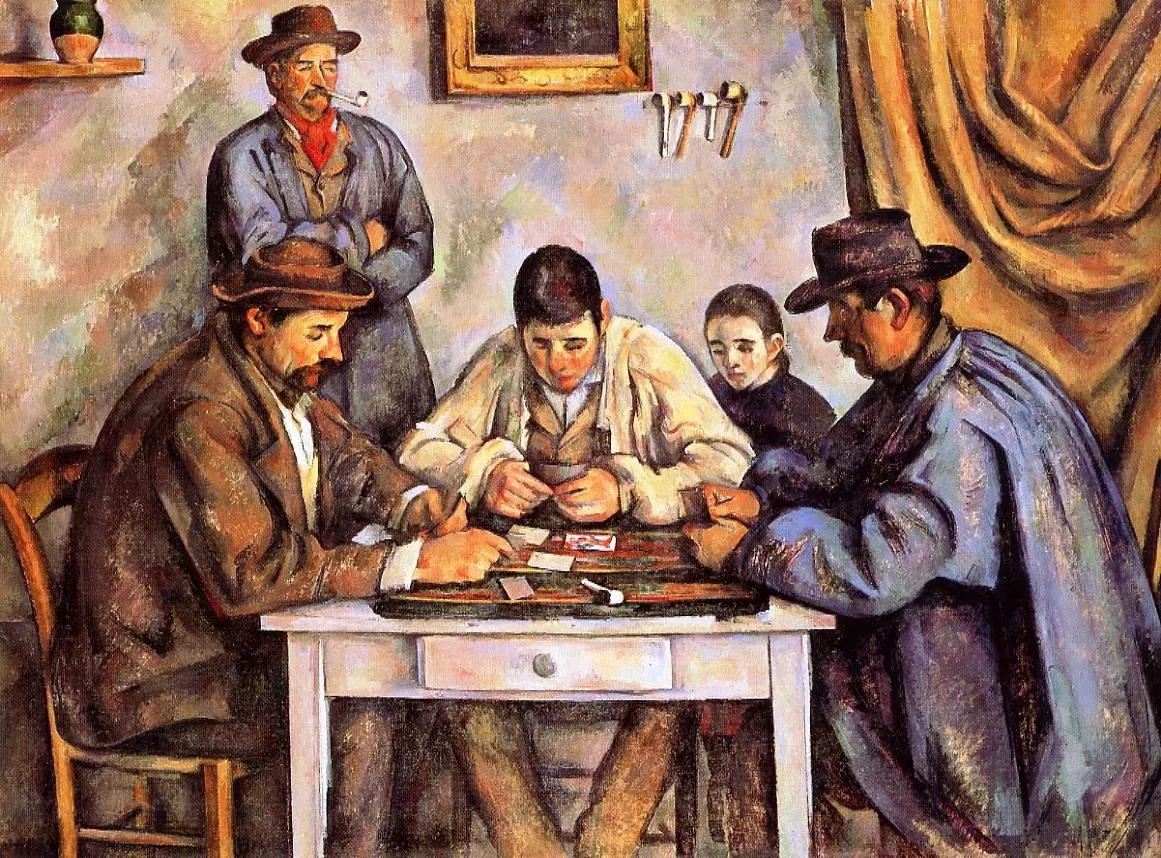 One of the smaller versions of the series, painted as Cézanne reduced the number of figures. Each version narrows the background and flattens the bodies further.
Why a Print Loses the Tablecloth
The Card Players depends on the surface of the paint. Cézanne worked in overlapping patches, sometimes with a palette knife, sometimes with a brush, and he left the edges between patches visible. Where the tablecloth changes from lit to shaded, there is no gradual transition. There are two patches of colour meeting at an edge, and the eye reads them as cloth folding across a table. This is the technique that later became the foundation of Cubism, and it does not survive a flat print.
A digital print lays pigment evenly across the whole image, so the visible edges that hold the composition collapse into a smooth gradient. The tablecloth becomes a single flat surface. The wall flattens into one ochre. The patches in the flesh, which in the original read as sculptural planes, become soft transitions that no longer describe anything.
A hand-painted oil reproduction rebuilds the surface the way Cézanne built it. The patches are laid down one by one, with visible edges, in the order Cézanne worked: the wall first, then the table and the cloth, then the bodies, then the hands and the cards last. The palette is matched to Cézanne's muted ochres and blues, and the surface is built up in overlapping layers so that the edges catch the light the way they do on the original canvas.
See The Card Players as a hand-painted oil reproduction at oilpaintings.com. The visible edges between patches are rebuilt by hand, in oil on canvas. View the painting
What to Look For
Start at the tablecloth and follow the edge of the cloth where it meets the table. Notice that the transition is not a gradient but a meeting point between two patches of colour. Then look at the two men and count the patches that make up each face. Then notice the small dark wine bottle behind the right-hand man. It has no highlight, no glass reflection, no label. It is a dark shape, and it holds the composition together the way a full stop holds a sentence.
Cézanne kept two of the Card Players canvases in his studio until his death in 1906. He exhibited the series only once during his lifetime, in 1895, at a show organised by Ambroise Vollard that included about 150 of his works and marked the first time the Paris public saw the Card Players as a group. Nobody bought them. Cézanne died eleven years later, in 1906, and the series was dispersed over the next decade. Within thirty years, Cézanne was being called the father of modern art. The Card Players is where that judgement starts.
A hand-painted oil reproduction on canvas, built in the same order Cézanne worked. The patches keep their visible edges, which is what holds the composition together.
Images: Paul Cezanne Art (paulcezanneart.org).